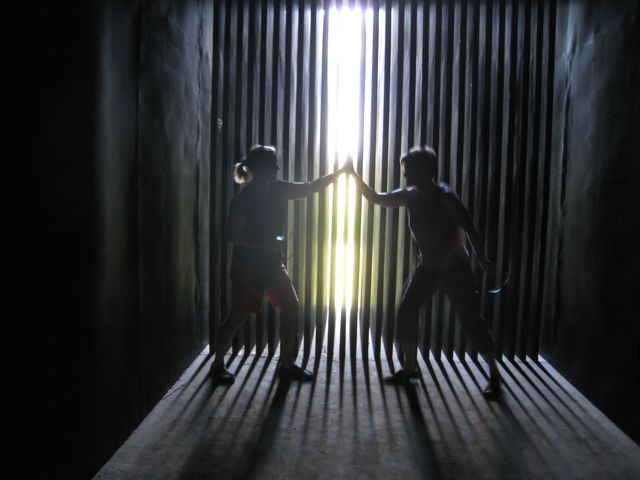
Flying fish?
 This picture is a study in line and form. The bodies of the the flamingoes weight the composition - partly because of their size, and the fact that they fill the bottom half of the picture, and partly because of the high color contrast. Gorgeous variations of red-orange vibrate against the complementary blue green of the water in the background.
 This simple image is actually more complex than it appears to be. Light streaming through a prism on the window ledge casts a band of color onto the tile countertop. The location is right at the edge of the bathroom mirror, so we see a literal mirror image - the colors on the counter plus the colors reflected in the mirror.
 Balance is developed several ways within a picture world. Locating the focal point - the spot your eye goes first - in the center of the composition, is defensible if my goal is to create a meditative piece, but it's a location that also risks being static.
 Personal taste or preference ranges over a very broad terrain. As a younger artist, I adored images and surfaces that were maxxed out visually. I couldn't get enough color, texture and metallic leafing.

 No surface designer worth his or her salt is capable of escaping the fascination with texture... but how to capture the original texture and make it a valid visual component? The Spanish moss references the barbed wire. The soft and natural world versus the contained and hard-edged human world. What to do?
 Oh happy day....That's what I think when I drive past this building. The graffiti is playful, and although NOT spontaneous - is driven by some spontaneous spark. I wish I knew the artist - so I could give credit where credit is due. Don't you think sometimes art that feels gorgeous and hopeful is worth the price of admission?
 This is interesting. My eye goes first to the clock, so that makes it the focal point. But it happens to be in an unorthodox location as focal points go - in the upper third of the picture and very close to the edge of the frame. Why doesn't it lead my eye out of the photo? Why do I have a sense of it being balanced, despite its location?
 I walk with my husband, for exercise and companionship. We were out after dark recently, and walked past an older home, on one of the side streets in the neighborhood. The bathroom light illuminated the sheer curtains and bathed the ornate perfume bottles in a soft glow. The difference between the warm, rich light and the harsh holiday lights strung up and down the block was rather jarring.

 I couldn't decide which image I like best, so I am posting all three. These pictures are interesting variations on the use of repetition. The mannequins are the focal point of each story, and the fact that there are several of them is key. Grouping the mannequins gives them visual weight. The bars of the thrift store door also contribute a repeating element. What role does it play when you study the photographs that include it?
 A study in texture and form. The subtle cream and gray tones play a supporting role in the development of the visual story, but the lead players are definitely the abstract form the bones create, and the texture generated by the massing of the elements.


 Posts
All Comments
Posts
All Comments